
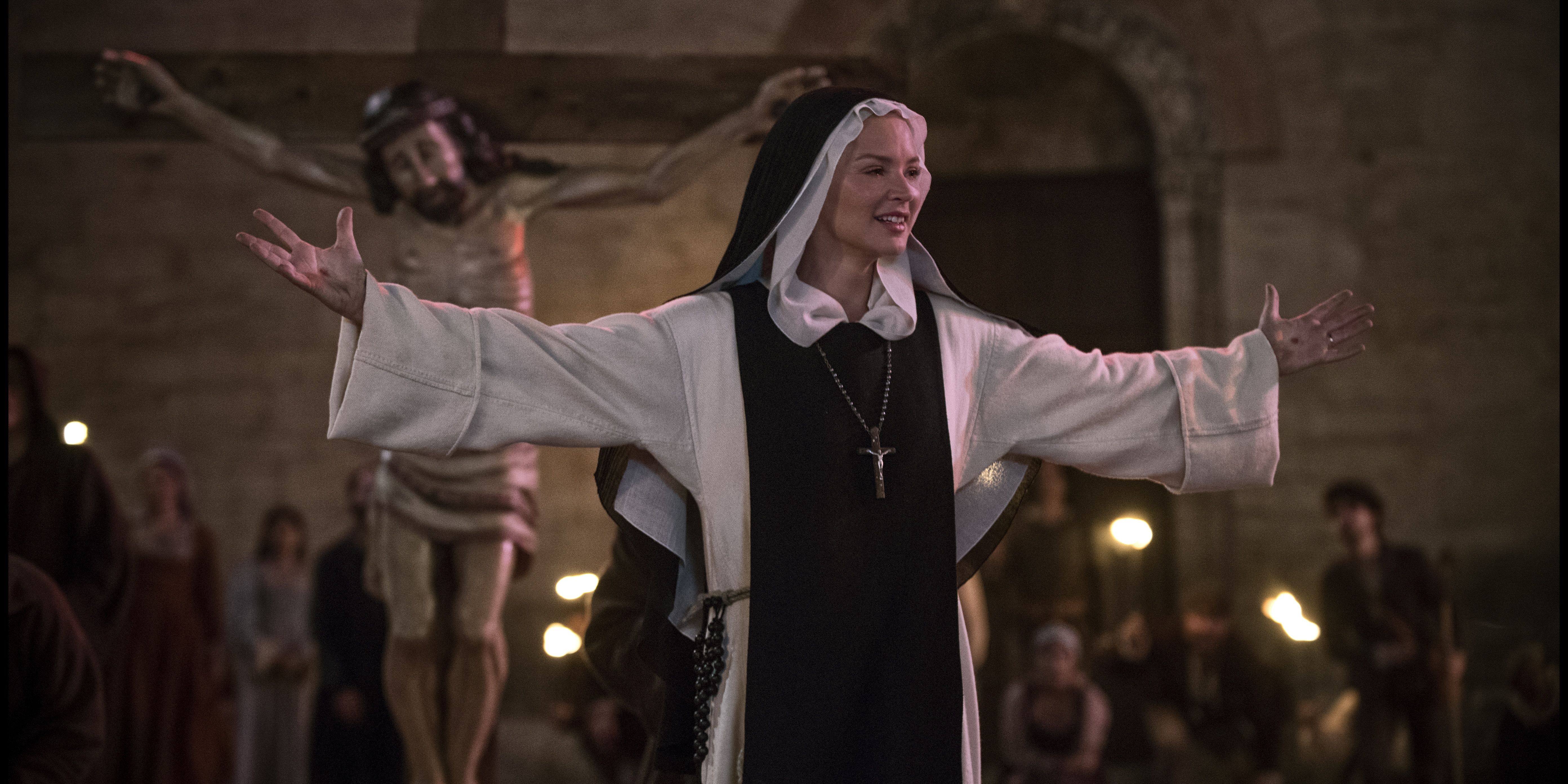
Given director Paul Verhoeven's reputation for controversy and provocation, it's no surprise that most of the coverage for his new film Benedetta focused on its salacious elements. There's plenty of graphic content in Benedetta, but the majority of the movie is an engrossing and relatively traditional historical biopic. Benedetta tells the true story of 17th-century Catholic nun Benedetta Carlini (Virginie Efira). Benedetta was a controversial figure in her time, renowned for her religious visions and vilified for her sexuality. Verhoeven plays up those elements while also offering an incisive (if unsubtle) critique of church hypocrisy.
It all falls within Verhoeven's familiar set of interests, especially in his current post-Hollywood period as he's returned to making films in Europe. Benedetta is Verhoeven's second French-language film, reteaming him with screenwriter David Birke, who wrote Verhoeven's even-more-provocative 2016 drama Elle. Like many of Verhoeven's female protagonists, Benedetta is confident and defiant, using whatever tools she can to rebel against the male-dominated power structure she's forced to live under. In the Italian town of Pescia in the early 17th century, that power structure is the Catholic church. One of the only ways for women to avoid being married off to abusive husbands is to devote themselves to God instead.
Benedetta doesn't have much choice in the matter, though, and she's an obedient if ethereal young girl. Unlike many of her sisters in the order, she's not fleeing horrifying circumstances: she's been promised to God by her middle-class father, as a sign of gratitude for her and her mother surviving her difficult birth. Soon after arriving at the convent, Benedetta experiences her first possible miracle while praying to a statue of the Virgin Mary: the statue falls from its perch, but Benedetta is unharmed. As she lies beneath the statue, she kisses the Virgin Mary's bare breast, in a blunt but amusing bit of foreshadowing.
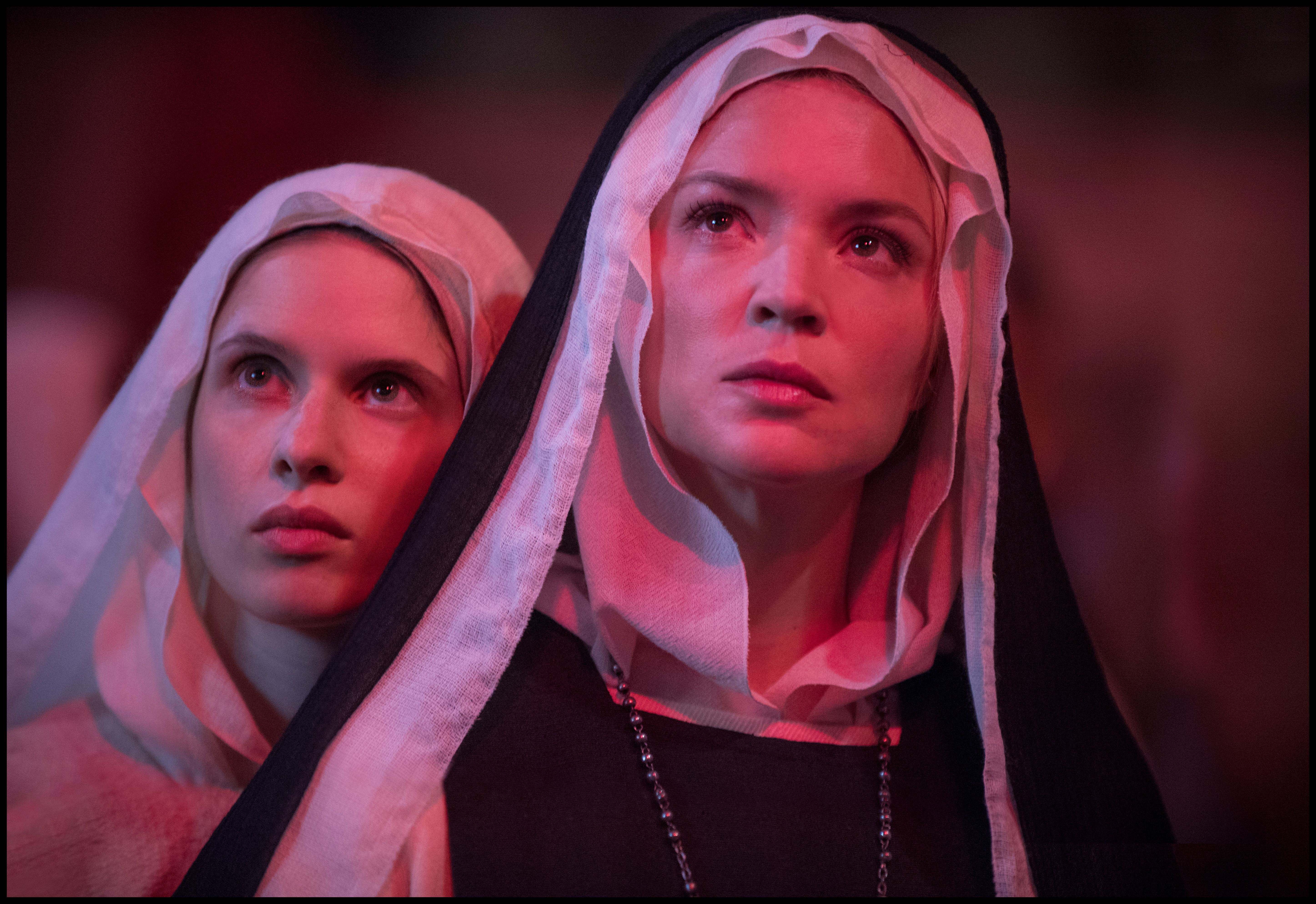
After the statue incident, the movie jumps ahead to Benedetta as an adult, by all accounts a pious and respected member of the Theatine nuns. That all changes with the arrival of Bartolomea (Daphné Patakia), who bursts into the convent as she's pursued by her nasty, abusive father. She demands sanctuary, but these Catholic orders are mercenary operations, and no one can become a bride of Christ without a dowry. Benedetta convinces her father to pay for Bartolomea to join the order, and the two women form an instant bond. Verhoeven, of course, stages their initial flirtatious banter while they sit side by side on the commode.
Having spent nearly her entire life in a convent, Benedetta is naive about carnal pleasures, but the more experienced Bartolomea is happy to show her. Benedetta's sexual awakening coincides with a spiritual awakening, manifested in often violent visions of Jesus Christ saving her. It's no coincidence that Benedetta experiences these visions just as she's opening herself up to a sexual relationship with Bartolomea. Benedetta goes into a trance-like state and experiences seizures. Soon the abbess (Charlotte Rampling) appoints Bartolomea as her full-time caregiver.
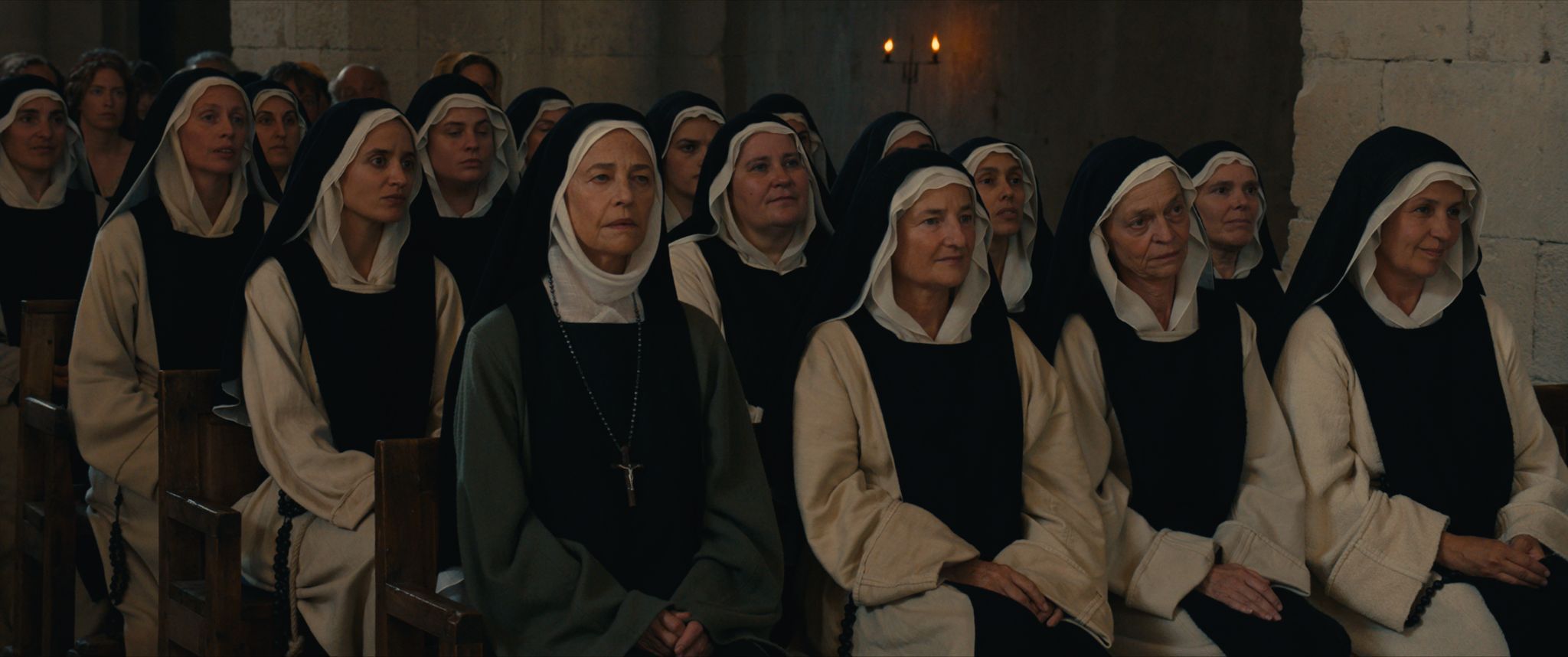
Verhoeven stages Benedetta's visions as over-the-top spectacles. As Benedetta achieves notoriety for her connection to Jesus, the film remains ambiguous on the true nature of her visions. She experiences stigmata and speaks in a guttural voice as if channeling God directly. While the townspeople begin to venerate her, the abbess and some of the other nuns grow suspicious. Efira plays Benedetta with a winking naughtiness, applying the same coy seductiveness to her religious experiences that she applies to her burgeoning romance with Bartolomea.
Eventually, Benedetta becomes so renowned that the regional provost appoints her abbess, demoting the previous abbess back to simple Sister Felicita. Rampling seethes with jealousy as the devoted servant of the church who's been overshadowed by a young, lustful blasphemer. The movie's third act is a grand battle between Benedetta and Felicita, who brings down the full weight of the Catholic church. Verhoeven builds the story to a bombastic climax in the midst of a bubonic plague outbreak, combining religious ecstasy with physical degradation.
Yes, there are some explicit sex scenes between Benedetta and Bartolomea. However, much of the film's nudity is functional rather than titillating. Even the most absurd sexual escapades are manifestations of Benedetta's emergence as a powerful woman. Efira makes the character into a fascinating enigma -- devious and devout. She's a true believer in her communion with God and in her love for Bartolomea as an expression of that communion. If she engages in deception, it's only because God wills her to: she firmly believes everything she does is for the glory of God.
That makes her a compelling historical figure if not quite the sexy seductress that some might expect from the director of Basic Instinct and Showgirls. Verhoeven always has something more on his mind even in his most prurient work. Benedetta balances his interests perfectly, freely mixing the sacred and the profane.
Benedetta opens Friday, Dec. 3 in select theaters and premieres Dec. 21 on VOD.


0 Comments